Welcome to the Dragon Folk Club

Welcome to the official blog of the Dragon Folk Club, which meets for a singers night every Friday at The Bridge Inn, Shortwood, Bristol. Everyone is welcome whether you sing, play or just listen.

Tuesday, 22 February 2022

With love

Coulter's Candy (Photo: alistair fitchett)
Sadly we were back down to two singers last week though there are even more promises of newcomers and visitors, so let's hope that comes to fruition soon. The sooner the better since this week one of the pair won't be around.

One plan to talk of is that we'll have a theme of Wales for a slightly belated St David's Day session on 4 March. As always the theme is optional but your efforts will be appreciated, and if a few songs about whales, daffodils, leeks and whatever creep in then that will be par for the course. As always, check Wikipedia for what St David is patron of apart from the obvious.

In the meantime, the session on 25 February will be theme-less so pretty much anything goes as long as it's acoustic.

Back to last Friday, we still seemed to have a few songs of love and lust left over from the previous week's Valentine's Day session, but some other things popped up as well. Colin was MC and started us off with Sing me a song Mr Bloom (Ian Walker). Mr Bloom is a character in the film 'Twilight Zone - The Movie'. In the film he visits homes for old people and, magically, turns them into children again.

Simon continued with another story, this time the Ballad of Patch Eye and Meg (Michelle Shocked). Sadly, but understandably, Michelle has expunged almost all of her songs from YouTube, so you'll have to search out her first album, The Texas Campfire Tapes if you want to hear it. Famously the album was recorded by a campfire at the Kerrville Folk Festival in Texas by Pete Lawrence using a Sony Walkman. Some people know that Michelle later disowned the album at one stage. What fewer people perhaps realise is that the battery of the Walkman that Lawrence used was running down, so the tape was transported more slowly than usual. This resulted in the published songs being faster and at a higher pitch than when Michelle originally sang them. It still sounds great though with the cicadas and trucks in the background.

A few of the videos I have included in the playlist at the usual "a selection" link below probably bear a little explanation, so I will use those as my theme for the week.

Simon experimentally brought out a song he has been threatening to sing for a long time. It is a pity that classical scholar Derek wasn't with us to hear it, but I'm sure it can be sung again sometime when he returns. The song was Flanders and Swann's The Hippopotamus Song, but this time sung in Latin. The version in question was sung by Ian Wallace at his inauguration as Rector of St Andrews University. His version is not on YouTube, but here is a recording of Ian singing The Hippopotamus Song in English on the BBC programme, The Good Old Days recorded at the Leeds City Varieties. There is a version in Latin on YouTube, but it's not the one.

Colin sang Chris Sugden's (Sid Kipper) By the cobblers which is set to the tune of Clementine (roud 9611). I have found a recording, but it is part of a much longer recording of a folk session on Zoom and I have no easy way of including the required part in the playlist - I wouldn't want you to have to listen to an hour of no doubt perfectly reasonable but off-topic singing just to listen to the Dragon playlist this week. So here, off-playlist, is a link to the appropriate part of the video.

Colin also sang Malvina Reynolds' version of Billy Boy (roud 326). It doesn't appear in the playlist because, like Colin, I can't find it on line, but here is are the words. Colin was concerned whether he had the right tune because Reynolds' words don't appear to fit the traditional one he knows, but he says they do seem to fit the one sung by Martin Carthy.

Simon sang Sovay (roud 7, laws N21), the tale of a young woman who dressed herself as a highwayman to test the commitment of her lover on his return. Simon mentioned that, like Colin's last song, he was influenced by Martin Carthy. However, he wanted to trace a recording of Isla St  Clair singing it on her 1980s children's television programme The Song and The Story. I didn't find that precise clip, but for the benefit of the playlist I found a recording of St Clair singing the song.

Colin can be assured that the song Elsie which he sang was indeed written by our friend Gary Hopwood.

It should be said that we don't tend to shy away from controversial words and topics when they are authentic; this is a folk club and we like to maintain the traditions. If anyone is squeamish then look away now. While Simon sang Oh Susanna (roud 9614), it wasn't quite as ... err ... historically accurate, as this recording.

I was particularly pleased to be able to roll out this recording when Colin sang Coulter's Candy (roud 19019) which was written by a former Galashiels weaver, Robert Coltart (1832–1880). The song was an advertising jingle for the aniseed-flavoured sweeties that he manufactured in Melrose and sold around the markets of the Border towns. The reason this video is special to us is because the singer is Helen Barr who used to occasionally visit the club from her home in Swindon.

I Fear IKEA, sung by Colin, is another song from the repertoire of Gary Hopwood, but under the slightly different title of I Hate IKEA. This one was however written by The Lancashire Hotpots.

Simon closed the session with Ian "Nobby" Dye's Bristol-based song Welsh Back Quay.

Now listen to a selection of songs sung during this session.

(Number of people present - 2 of whom 2 performed)

Tuesday, 15 February 2022

Valentine's Day 2022

Last Friday it was good to see Mike back in fine voice following a dog-related incident which had kept him away. The said dog (Indy) was also present and had obviously been practising his scales. We had met to sing songs of love and lust for Valentine's Day (slightly prematurely) and that is pretty much what we did.

Colin, MCing as usual, started us off with Ralph McTell's The girl from the hiring fair. Simon followed with Scarborough Fair (roud 12, child 2) and Mike completed the first rotation with Come write me down (roud 381).

The only exception I have spotted to the love and lust theme was Mike's parting song, All the good times (Bob Pegg).

There were some doubles, the first one I noticed was Simon unusually singing two songs from Dolly Parton: Love is like a butterfly and Jolene.

Some humour came from Colin singing The Kipper Family's version of Soldier, soldier (roud 489), entitled The Disabled Seaman. This was also the only song from the evening for which I have been unable to find a YouTube recording.

Simon sang some songs more often sung by Colin: Running Bear (Jiles Perry Richardson "The Big Bopper") and Me and Bobby McGee (Kris Kristofferson, Fred Foster). In return Colin sang She Moves Through The Fair (roud 861) which Simon sometimes sings.

Colin took on quite a task of singing John Jacob Niles' song Venezuela, while Simon's biggest challenge may have been the guitar accompaniment for Margarita (Harvey Andrews).

Colin closed the evening with the second part of another double, this time from Donovan. He had earlier sung To sing for you, and now finished is off with Josie.

Now listen to a selection of songs sung during this session.

(Number of people present - 3 of whom 3 performed)

Tuesday, 8 February 2022

Is brevity a virtue?

(Photo: Simon Meeds)
After last week's marathon report I will keep this one brief. As you can see our stone may have rolled but it hasn't yet gathered any more singers (or audience members). Nevertheless we are gaining promises from an increasing number of people that they will join us shortly. If you are one of those people then please get down to Shortwood on a Friday night soon. If you haven't already pledged your presence then get down anyway with a song, tune, story, poem, monologue or any type of performance as long as it's acoustic.

While we're on the subject of the future, we don't really get too fussy about themes but there are a couple of obvious ones this Friday. Traditionally for Valentine's Day the theme is "love and lust", but if you would rather bring out some sport for the Winter Olympics, that's fine too. Otherwise just forget about themes and do whatever you fancy.

Colin, MC as usual, started off the session with Pete Seeger's Get up and Go.

Simon decided to mark the passing of Norma Waterson by singing three songs from Norma or The Watersons: Bunch of Thyme (roud 3), Country Life (roud 1752) and The Souling Song (roud 304). Colin added to the group Three Day Millionaire (Mike Waterson).

The only song sung during the evening which doesn't appear in the playlist linked with "a selection" below was Ballad of Real Ale (Kevin Pratt) which was sung by Colin.

The evenign was closed by Simon who sang The Ryans and the Pittmans (roud 21113).

Now listen to a selection of songs sung during this session.

(Number of people present - 2 of whom 2 performed)

Monday, 31 January 2022

A song and a story

Softcover book catalogue of The Family of Man exhibition
We were low on numbers again but not on singing. It was not our fault that we got through only fourteen songs. Just before 10 o'clock the landlady knocked on our door and said we were the only customers, so they were clearing up early. We agreed to sing two more songs and get out. If only we had more people we may have been able to justify them keeping the place open for the remaining hour.

Colin was MC and started the evening with Steve Knightley's All at Sea.

Simon remained at sea or at perhaps returned to harbour with The Last Farewell (Roger Whittaker, Ron A Webster). Whittaker hosted a radio programme in 1971, backed by a full orchestra with arrangements by Zack Lawrence. Whittaker is quoted as saying that "one of the ideas I had was to invite listeners to send their poems or lyrics to me and I would make songs out of them. We got a million replies, and I did one each week for 26 weeks". Ron A Webster, a silversmith from Birmingham, England, sent Whittaker his poem entitled "The Last Farewell", and this became one of the selections to appear on the radio programme. It was subsequently recorded and featured on Whittaker's 1971 album New World in the Morning.

Colin gave us Sydney Carter's John BallJohn Ball was an English priest who took a prominent part in the Peasants' Revolt of 1381.

Simon sang The Galway Shawl (roud 2737). Simon mentioned that when he sang it at another gathering a few months ago, someone had suggested it was a non-political Irish song. Another of the people present proceeded to work through the song showing that by the use of more or less obscure references it was in fact possibly one of the many political Irish songs.

Colin brought us The Ballad of Seth Davy. The song was written by Glyn Hughes in the late 1950s. Seth Davy was a popular street entertainer during the 1890s in Liverpool.

He was originally a sailor from Jamaica but Seth Davy became a fixed character on the streets of Liverpool where he entertained people, and especially young children, with his three dancing dolls which he made himself. The famous dancing dolls were attached to the end of a plank which Seth Davy would tap with his hand to make them dance while he crooned his minstrel songs. Seth Davy’s stage was the street outside the Bevington Bush Hotel on the north side of the city of Liverpool. He was known to sing minstrel songs and his most popular one which he was often heard singing was called ‘Massa is a Stingy Man.’ It is an old minstrel song from across the Atlantic and it contains the lines which would go on to form the later ballad about the street entertainer: ‘Sing come day go day, god send Sunday, we’ll drink whiskey all the week, and butter milk on Sunday.’

The song has particular interest for us since our friend Tom Mossman remembers his grandfather having dolls which danced on a plank. Sadly when he died the dolls were thrown out before Tom had a chance to save them.

Simon sang Sugar in the Hold Below which he got from the singing of The Longest Johns. Simon is visible in the audience in the linked video. It was a river steamboat song the earliest record of which occurs in 1924, but it probably predated that. The JM White in the song was a steamboat famed for its technological advancements that travelled the New Orleans to Greenville trade route, and was supposed to have been the fastest ship to have steamed that line.

The Family of Man, sung by Colin, was written by Karl "Fred" Dallas after he saw the exhibition of the same name. It was an ambitious exhibition of 503 photographs from 68 countries curated by Edward Steichen, the director of the New York City Museum of Modern Art's Department of Photography. According to Steichen, the exhibition represented the "culmination of his career." The title of the exhibition was in turn taken from a line in a Carl Sandburg poem.

The Wizard of Alderley Edge, written by Pete Coe, was sung by Simon. It tells a story relating to the supposed sleeping knights of Alderley Edge in Cheshire. Nell Beck, mentioned in the song, refers to a legend about an unfortunate servant girl, Ellen Beck, who like the Wizard, knew where to find the iron gates which gave entry to the underworld. She saw the iron gates and described them as a pair of folding iron gates situated not far from the holy well, but when she returned to show another person the gates were nowhere to be found. After this the tale of her life is a sad one. Apparently records show that an Eleanor Beck was baptised at Wilmslow church on 13 February 1721.

Roger Davies' song, Brighouse on a Saturday Night, tells more recent tales of that town in West Yorkshire. The Richard Oastler pub referred to in the song was previously a Methodist chapel. Our friend Richard Gillion used to tell us that his grandparents were married there. In November 1977, The Brighouse and Rastrick Brass Band, also mentioned in the song, reached number two in the UK Singles Chart with its recording of The Floral Dance (1911 - words and music by Kate Emily Barkley 'Katie' Moss), where it stayed for six weeks.

Simon gave us I Am a Rock (Paul Simon). Paul Simon first recorded the song in May 1965. It was included on his solo-acoustic The Paul Simon Songbook LP released in the UK in the summer of 1965. Until 1981, this initial recording remained unavailable in North America partly because Paul Simon himself was dissatisfied with the album.

Colin referred to Mike's singing of Keith Marsden songs and presented his own version of Marsden's Prospect Providence. 'Prospect' and 'Providence', along with 'Albert', 'Valley' and 'Crank', were the names of some of the mills that dominated Morley (near Leeds) in the boom years of the Industrial Revolution.

While Northwest Passage (Stan Rogers) clearly refers to John Franklin's ill-fated 1845 attempt to traverse the Northwest Passage, as well as to other explorations, its theme is really to compare the songwriter's own travels to those of men in history.

Famously, many people mistakenly think that Dirty Old Town (Ewan MacColl) which Colin sang, is an Irish Song. Not only is it not Irish, but it is about Salford in the North West of England. Simon pointed out that some of the rough areas mentioned in the song are now taken over by MediaCityUK, mixed-use property development on the banks of the Manchester Ship Canal. Tenants include the BBC, Granada TV and ITV studios.

Closing the evening fell to Simon who sang When All Men Sing (Keith Scowcroft, Derek Gifford).

Now listen to a selection of songs sung during this session.

(Number of people present - 2 of whom 2 performed)

Tuesday, 25 January 2022

Burns' Night 2022

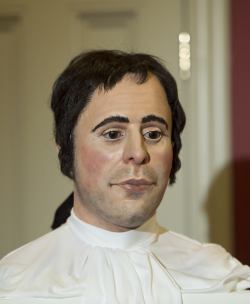
Robert Burns
It was a cosy early Burns' Night before a blazing fire. Who am I kidding, but with unseasonably mild weather I'm not complaining either. I've had my haggis and tatties and neeps since then, have you? We met on Friday to sing Scottish songs, and with a little poetic licence here and there that's what we did.

MC Colin went against tradition and asked Simon to start the evening which he did, with an actual Burns song, or at least one of those he collected and changed to be his own, Ye Jacobites by Name (roud V31021). Colin kept it Burns with Such A Parcel Of Rogues In A Nation (roud V31022 - sequential roud numbers no less!).

Most of the remaining songs were Scottish, though not all Burns by any means. I will mention some of the more eccentric or less Scottish ones.

Colin brought out his customary ode to the chieftain of the pudding race, no not Address to a Haggis (Robert Burns) but Captain Beaky's offering: Haggis Season (Jeremy Lloyd, Jim Parker).

Simon's regular song, The Handweaver and the Factory Maid (roud 17771) is generally accepted to be from either Lancashire or Ireland. The version Simon got from the singing of Sylvia Barnes is clearly based in Glasgow. Whether it is traditional or Sylvia's own rewrite we do not know, but Roud doesn't list a Scottish version.

Colin borrowed from the repertoire of The Smothers Brothers the song Eskimo Dog (Dick Smothers, Tom Smothers), replacing "North Pole" in the first line of the first verse with "Scotland". The song is a parody of Whiskey in the Jar (roud 533).

Colin's A Scottish Holiday (JW "Bill" Hill) is a parody of The Road to the Isles (roud 32843). We learn that Bill is a retired local government officer who also worked in the field of education. He wrote some of the funniest songs to have come out of Scotland before retiring from the music circuit due to family commitments. He is now an Edinburgh tour guide.

It fell to Simon to close the evening which he did with what on the face of it is an Irish Song. Wild Mountain Thyme was written by France McPeake, but it is based on The Braes of Balquhither (roud 541) by Scottish poet Robert Tannahill (1774–1810) and Scottish composer Robert Archibald Smith (1780–1829).

Now listen to a selection of songs sung during this session.

(Number of people present - 2 of whom 2 performed)

Tuesday, 18 January 2022

Between New Year and Burns

Anarchist trial defendants Bartolomeo Vanzetti (left)
and Nicola Sacco
Last Friday's session at The Bridge saw an increase of 50% in the number of singers after the previous week. Let's hope this starts a trend. Come and join us this week (21st January) with an informal Scottish theme for Burns' Night. Don't worry if you can't match the theme; everyone is welcome to sing whatever they fancy as long as it's acoustic (tunes, poems, stories, monologues, jokes... are also welcome).

Back to last week, Colin was MC as usual and started off the evening with Coal Hole Cavalry written by Ted Edwards who was brought up in the coal mining community of Wigan. He used to lie in bed as a small child and listen to all these early morning sounds around him, then imagine the miners in clogs as a cavalry charge, off to remove the Indians who'd taken over the mine during the night.

Mike was still singing of the new year with Richard Thompson's We Sing Hallelujah. Meanwhile Simon was prematurely Scottish, singing Geordie (roud 90, child 209).

Colin pondered whether he had recently sung Two Good Arms (Charlie King), and having established that he probably hadn't, proceeded to do so. King wrote the song in 1977, for the 50th anniversary of the execution of Sacco and Vanzetti (see photo).

Mike was still marking the new year with The Happy Man (roud 1230), a Morris Stick Dance and Song collected in Adderbury, Oxfordshire.

Colin's next song, written by Stan Kelly and Eric Winter, Come-All-Ye And Go-Back-Again is a parody of a multitude of folk songs. Kelly wrote: 'The line "Come all you gallant mariners/ shopwalkers/ computer engineers..." or what-have-youse is folk song's commonest curtain raiser. Its only real purpose is to get the audience quiet before you begin to unfold the story. One night, I found I had to sing three verses of throw-away lines before I could get hush and, when I mentioned this to Eric Winter on one occasion, it set us thinking that there must be somewhere a prototypical martyr ballad consisting of all the best introductory and closing lines. Together, Eric and I produced this masterpiece, this do-it-yourself song kit that needs only the name of your favourite hero to be inserted at strategic places.' It's worth noting that Stan Kelly-Bootle to give him his full name was a computer scientist having achieved the first postgraduate degree in computer science in 1954, from the University of Cambridge.

Mike noted that Dave Goulder's The January Man had been sung by Simon the week before in his absence, and sung it anyway "because it's the only time of year I sing it". Colin couldn't recall Simon having sung The Gentleman Soldier (roud 178) before, but he certainly had, here at least, but no doubt a few other times.

Colin gave us Sean Bhean-Bhocht which is a traditional Irish song from the period of the Irish Rebellion of 1798, and dating in particular to the lead up to a French expedition to Bantry Bay, that ultimately failed to get ashore in 1796. Let's also have a listen to it in Gaelic: An tSeanbhean Bhocht. Wikipedia tells us that the title literally means "poor old woman" and was used as a personification of Ireland in the 18th century.

I think Mike meant his singing of The Oak and the Ash (roud 1367, laws K43B) to pre-empt Burns' Night, but I couldn't find a reference to anything I could recognise as it on robertburns.org. Mike sang it as "...in the West Country"; I couldn't find a recording with that wording so, since we had been talking about various versions, I linked something which seems to me at least more obscure.

When Simon sang Tom of Bedlam (roud V16366; tune Dave Moran, Nic Jones) there was no expectation that it would be the last song of the evening. However, after Mike left the room, we moved into chat mode which carried on for the rest of the evening so this was as it turned out, the finishing off song.

Now listen to a selection of songs sung during this session.

(Number of people present - 3 of whom 3 performed)

Tuesday, 11 January 2022

A Happy New Year

Colin (Photo: Simon Meeds)
It was a quiet start to the new year last Friday at the Dragon Folk Club, but we have high hopes for a return to better numbers in the near future as long as COVID doesn't stick its oar in too much. The unofficial theme that emerged was naturally New Year with a bit of a Christmas hangover.

Colin, MC as ever, started us off with Peggy Seeger's Come Fill Up Your Glasses.

Simon got his New Year offerings in quickly before the people who usually sing them arrived (they didn't). From Derek's repertoire he picked Kind Country Lovers (roud 3483) which is associated with Twelfth Night. From Mike's repertoire he took Dave Goulder's The January Man.

Colin gave us quite a selection of Christmas parodies from The Kipper Family. Sid Kipper (Chris Sugden) understandably keeps recordings off the web as far as possible, but those Colin sang were:

Simon gave us another parody, though an untypically subtle one for Les Barker: Lord Franklin.

Colin led and we sang together Worried Man Blues (roud 4753).

The evening was closed with Simon singing a suitably wintry Down Our Street ().

Now listen to a selection of songs sung during this session.

(Number of people present - 2 of whom 2 performed)